
Mandated Reporting
A person who is required to report known or suspected instances of child abuse or neglect

The Child Abuse Prevention and Treatment Act (CAPTA) was passed as a federal law in 1974. Starting from this, society began to have “mandated reporters.”
This person has a mandate— an official order— to report suspected child abuse. They do not have to have definitive proof of abuse, they need only suspect that abuse might be occurring. This is grounds enough to warrant a report to child protective services, prompting an investigation.
The legal definition of a “mandated reporter” is “a person who is required to report known or suspected instances of child abuse and/or neglect if they, in their professional capacity or within the scope of their employment, observe a child who appears to be a victim of abuse, neglect, or exploitation.”
Some states require all people to report child abuse, or at least have laws to the effect. Other states identify specific professionals as mandated reporters.
Then, different states have different roles selected as “mandated reporters.” Roles designated as mandated reporters are often those that have ongoing contact with children (i.e. education) or occasional, intimate contact with children (i.e. healthcare). Someone with ongoing contact with a child might be able to observe gradual changes in behavior or health, whereas a doctor or nurse might be able to observe suspicious bruising or other physical indicators.
People in these roles go through training to identify the signs of abuse and have a legal (and moral) obligation to report suspected child abuse.
When confronted with the child abuse (the suspicion thereof, or blaring evidence thereof)— there’s a range of responses. Some people default to psychological avoidance; they push the possibility out of their minds as improbable or “not-my-business.” This brings immediate emotional relief from the stress induced by the thought of child abuse but comes with long-term negative consequences— both for the child (who may continue to experience neglect/abuse) and the would-be reporter (guilt, regret, shame, helplessness).
There may also be story-making and excuse-gifting. You make up a story for how the suspicion could be allayed. Or the stubborn resistance of NIMBY (“not in my backyard”), some mental acrobatics where one knows that child abuse happens as a fact of reality, but refuses to believe such plights come to their proximity.
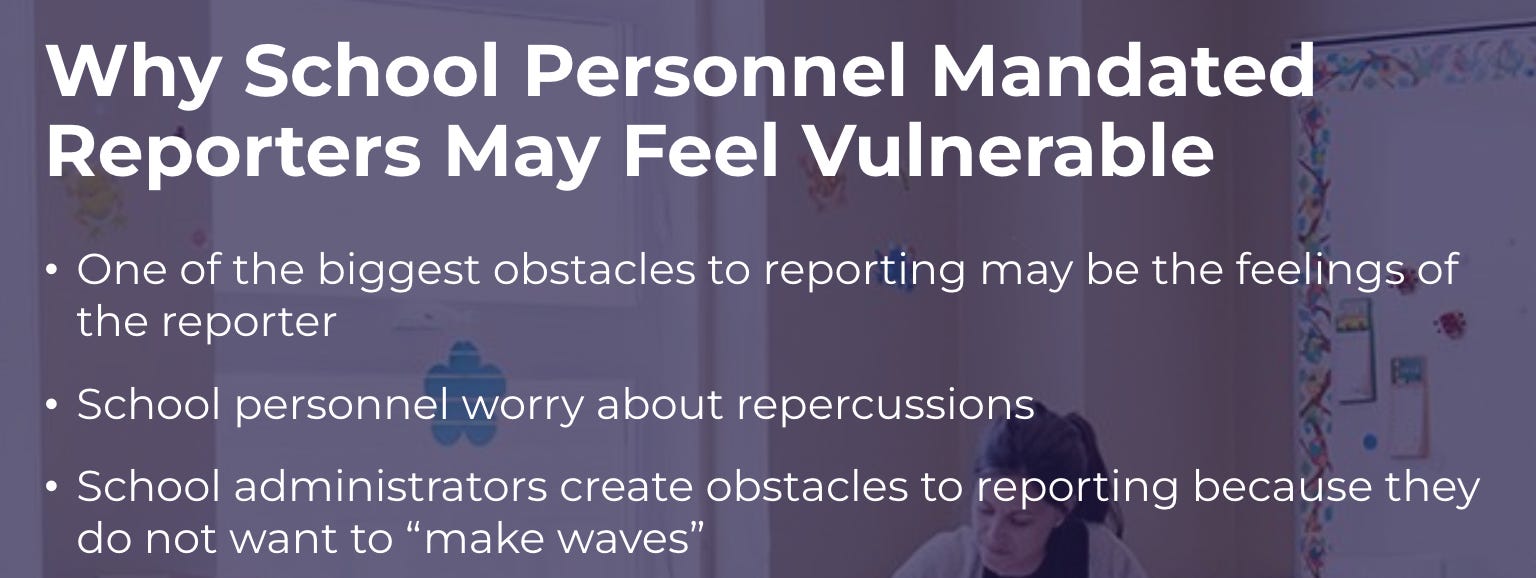
I recently reviewed some mandated reporter training. It caught my attention that the training said that “one of the biggest obstacles to reporting may be the feelings of the reporter.” The training also pointed out that someone in a mandated reporter role (i.e. teachers) “may spend more hours per day with children than their families do.”
Have you ever reported child abuse? What was the experience like?
Have you ever felt a mandated reporter did not rise to her/his responsibilities?
Have you ever felt you ought not to make a report?
Dear Lauren, thank you so much for your comment. It is always meaningful to me when readers share their experience or thoughts on a piece. I'm reflecting on what you've said and will respond in full a bit later. As a fellow survivor, I applaud and celebrate you. And I am glad we have survived, and live on to help others.
Mandated reporting is great in theory. As a victim/ survivor of domestic violence, it kept me from opening up to anyone who might make a report.
My concern was that if it was reported before I separated from my abuser, that it would increase the abuse and our abuser would make it harder to leave.
Another case is my friend’s kid’s school. They’ve seen countless families drop off kids that should be in booster or car seats that aren’t. On one hand, it’s likely the majority can’t afford them and are good parents otherwise but on the other is that it’s so incredibly dangerous for those kids every car ride. The teachers at the school don’t report it even though they’re supposed to. My friend wishes there was something she could do.